Car AC Only Blows Cold When Driving? Causes and Checks
Your car's AC cools the cabin on an open road, then turns warm at a traffic light. That change is useful diagnostic information. It does not, by itself, tell you to buy a compressor or book another refrigerant refill.
- AC that cools while moving but warms at idle needs a check of the conditions that change between those situations, including condenser airflow and compressor operation.
- A strong stream of warm air is a different symptom from barely any air leaving the vents. Record which one you have before discussing parts.
- The condenser releases refrigerant heat to outside air. DENSO: condenser operation.
- DENSO describes reduced cooling during some engine stop-start events. DENSO: start-stop and cooling.

Why can car AC work while driving but warm up at idle?
The AC system transfers heat out of the passenger compartment. The condenser releases that heat to outside air, as explained in DENSO's condenser overview. A change in airflow through that heat exchanger can therefore matter when road speed changes.
- This makes condenser airflow worth investigating, but it is not a diagnosis. HELLA's air-conditioning troubleshooting guide lists different faults behind poor cooling, including condenser contamination, fan problems and refrigerant-charge problems. Test results must distinguish them.
- Describe the pattern precisely: the blower setting stays the same, the volume of air feels unchanged, but its temperature changes after you stop. That description gives the workshop more to work with than “the air conditioning is weak.”
Avoid testing by repeatedly revving the engine in a parking space. It does not isolate road airflow from the other operating conditions and is not a substitute for an inspection.
Why does the air conditioner blow cold air only while driving?
The AC condenser needs to release heat. Road movement changes airflow, while a stationary car relies on its fitted airflow arrangements. DENSO AC-servicing guidance explains why operating conditions and system design matter when interpreting a cooling complaint.
A condenser fan problem is therefore a relevant possibility when cold air returns during normal driving. It is not the only possibility. Restricted airflow, compressor control and other refrigerant-system conditions need their own assessment.
Tell the technician whether the vent air warms while its volume stays similar, whether airflow from the vents also weakens, and whether engine temperature changes. Those observations distinguish a temperature complaint from a cabin-airflow complaint and can help identify the checks needed.
Does an AC recharge fix every car that only blows cold while driving?
No. A recharge changes refrigerant quantity under the required service procedure. It does not repair a failed fan, restore a damaged electrical supply or remove every airflow restriction. The first question is what the inspection established about this system.
DENSO’s diagnosis discussion warns against interpreting modern systems only through familiar pressure assumptions. Variable compressor operation can require additional information, including temperatures and the actual operating state.
The service should identify the correct refrigerant and charging requirement for the vehicle. If a leak or another component fault is found, the proposal should show the associated work. Repeated top-ups without investigating confirmed loss do not resolve the leak.
A useful completion check compares the relevant stationary and moving conditions where safe and appropriate. A car that briefly blows cold in the workshop has not necessarily been checked under the original traffic condition.
Is the air warm, or is the airflow weak?
Use separate words for temperature and airflow. The difference helps the workshop decide which observations to reproduce and which part of the system to examine first.
| What you notice | What to record | What the observation does not prove |
|---|---|---|
| Strong airflow becomes warm when stopped | Whether the engine is still running and whether the pattern repeats | That the compressor needs replacement |
| Little air reaches the vents | Blower setting, outlet selection and whether all outlets behave alike | That adding refrigerant will restore airflow |
| Cooling improves briefly after a refill | Date, invoice and how soon the symptom returned | The location or size of any leak |
| One outlet behaves differently | Which outlet and the temperature settings for each zone | That the entire system has lost refrigerant |
| Cooling changes with an engine warning | Warning symbol and whether temperature is rising | That it is safe to continue a test drive |
A cabin filter and a condenser are different parts with different jobs. The Bosch Car Service AC overview separates cabin-filter care from refrigerant-system servicing. Ask which fault a proposed filter replacement is expected to address.
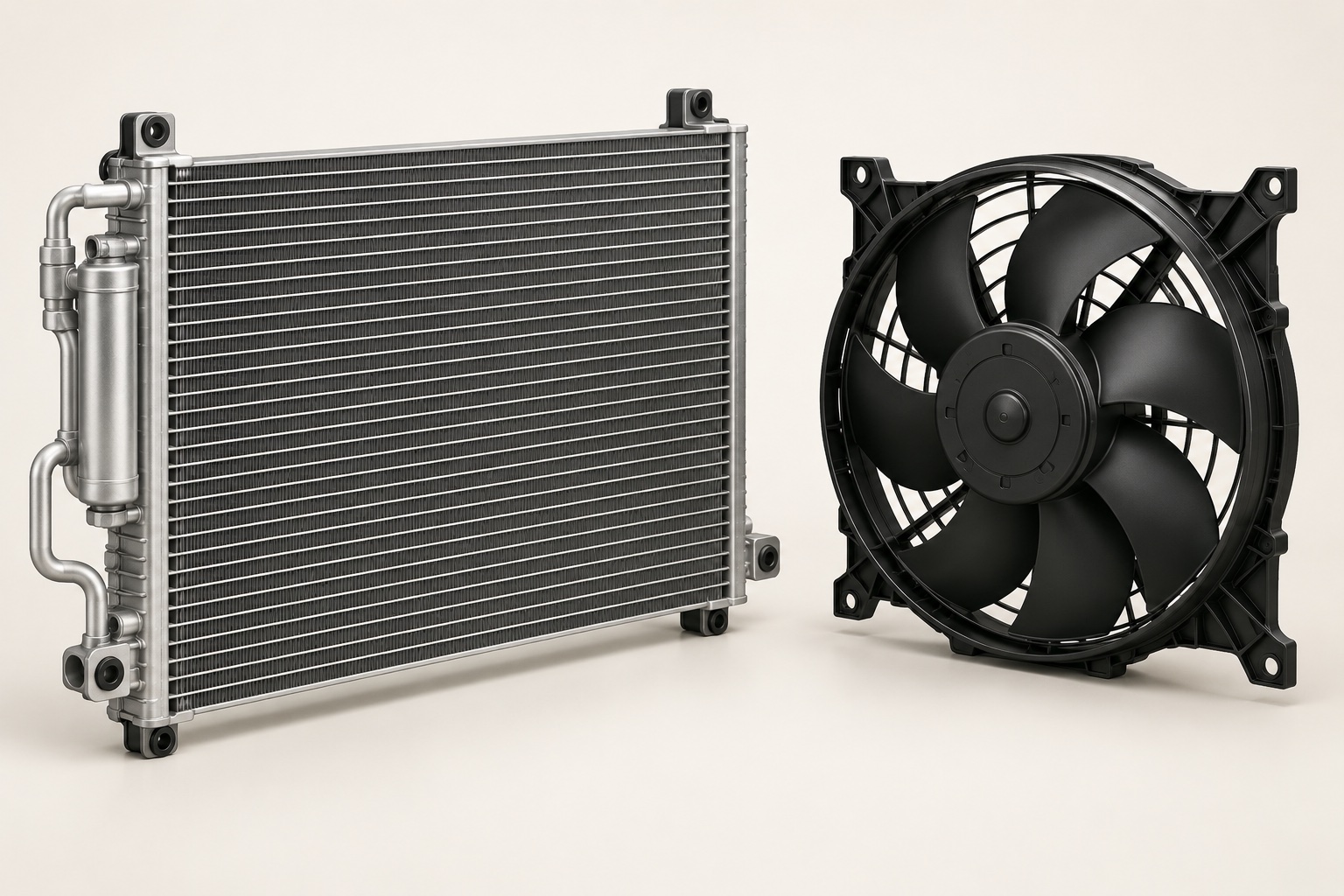 Concept illustration of separate components, not a vehicle-specific installation diagram.
Could this be normal start-stop behavior?
In some vehicles, engine stop-start operation changes AC performance. DENSO's driver guidance notes that cooling can reduce when the engine stops and the compressor stops with it. This explanation is vehicle-dependent.
Check the handbook for your model's climate-control and start-stop behavior. Record whether the cooling change happens only when the engine shuts off, or also while it continues idling. That distinction belongs in the service request.
Do not assume every hybrid, electric car or newer petrol car uses the same compressor arrangement. Give the workshop the exact model and powertrain before accepting an explanation based only on engine speed.
When does the problem need more urgent attention?
A warm cabin and an overheating engine are not the same complaint. If an engine-temperature warning appears, follow the vehicle's instructions for stopping safely. Do not keep driving merely because the AC becomes cooler at speed.
Engine-cooling faults require their own assessment. HELLA's cooling-system checklist covers components and tests involved in identifying cooling problems. It should not be used as a roadside DIY procedure or as proof that a thermostat is the cause.
Do not open a hot cooling-system cap or work around running belts and fans. If you cannot safely use the vehicle, arrange assistance and explain the warning to the operator. Tell the workshop about the engine-temperature symptom before asking for a recharge.
Why can checking AC pressure alone miss the cause of poor cooling?
Pressure is one diagnostic input, not a complete description of system operation. DENSO’s AC diagnosis explanation notes that electronically controlled variable-displacement compressors also require attention to temperatures and live data. A pressure reading needs the operating conditions and fitted system to be interpreted.
This matters when the AC works in motion but warms up at a stop. Fan response, heat rejection, compressor control and the cabin air path are different questions. A technician should connect the measured condition with the proposed repair rather than treat one gauge reading as automatic permission to add refrigerant.
The report can identify the conditions under which performance was checked, the relevant measured findings and any command-versus-response problem. Ask what finding shows the refill, fan repair or compressor work is needed. Those options do not cover the same fault and should not be presented as interchangeable service packages.
What should an AC estimate say about refrigerant and compressor oil?
The refrigerant type, required charge and applicable oil information belong to the exact vehicle and compressor arrangement. The correct quantity cannot be inferred from engine size or from a generic chart for another model. The technician should use the vehicle information and the applicable service procedure.
DENSO AC service guidance includes refrigerant and oil quality alongside checks of airflow, air mixing, fan operation and noise. A service record should make clear which work was performed and which problem it was meant to address.
If a leak is found, ask how its location was established and what the repair includes. Repeated topping up and correcting a confirmed leak are different scopes. If a component is replaced, the proposal should explain any associated material or cleaning requirement that applies to the fitted system.
Keep driver observations practical: whether air volume falls, whether vent temperature changes, whether both sides differ and whether the condition appears only at a stop. Do not reach near a fan or open the pressurised refrigerant circuit. The workshop needs a description of the change; handling and interpreting the AC system belong to the qualified technician.
How do you choose the next service step in Sharjah?
When your AC works fine on the highway but not in traffic, start by describing that pattern. The AC service page explains the questions to ask about airflow, refrigerant loss, controls and compressor operation before selecting work.
AS Auto Repair Garage Sharjah lists its location in Industrial Area 10. Use the contact page to confirm an appointment and the assessment available for your vehicle. Ask for the inspection findings and a written estimate before agreeing to repairs.
If compressor work has been proposed, ask what inspection result supports it. A written scope should distinguish assessment from repair and should explain what happens if another fault is found. Keep the original invoice and the final report together so that a returning symptom can be compared with the earlier findings.
Frequently asked questions
Does cold air while driving rule out a refrigerant problem?
No. The pattern alone does not establish refrigerant quantity or eliminate other causes. Tell the technician when cooling changes and ask how the proposed tests distinguish the possibilities.
Will replacing the cabin filter fix warm air at idle?
A filter concern and a temperature concern should be assessed separately. If air volume is poor, mention that specifically. Do not assume a filter change will solve a symptom where airflow stays strong but the air becomes warm.
Should I replace the compressor first?
Ask for diagnostic evidence before approving replacement. The same complaint can lead to different repairs, so the symptom alone is not enough to select a compressor.
Can I diagnose this with a refill can and its gauge?
A recharge product does not replace identification of the refrigerant, the vehicle's specifications or a system assessment. Ask a qualified technician to establish the cause rather than adding refrigerant on the strength of warm air alone.
What should I ask after the repair?
Ask whether the original stopped-versus-moving complaint was checked again, what was repaired, and whether anything still requires attention. Keep the answer with the invoice.
Is this guide a repair procedure for my vehicle?
No. It helps you describe a symptom and understand the inspection questions. The correct tests, refrigerant, components and procedures depend on the vehicle's service information.
Why is my car AC warm when stationary but cold when driving?
Road movement changes airflow across the heat exchangers. A condenser-airflow or fan problem is one possible route, but refrigerant, compressor control and operating conditions also need assessment. Separate warm vent air from a rising engine-temperature indication, because those observations can change the urgency.
Will recharging the AC fix cooling that fails at idle?
Only a properly established refrigerant-related finding supports that work. Recharging does not repair a fan circuit or compressor-control fault. Modern variable-compressor systems can also need temperature and control information beyond a pressure reading. Identify the cause before treating a refill as the remedy.
Final answer
- Describe airflow, temperature and operating conditions separately; they are different observations.
- Ask for evidence before choosing a refill, cleaning or part replacement.
- Treat engine-temperature warnings according to the vehicle handbook and arrange assistance when continuing is unsafe.