Car Thermostat Problems: Symptoms and Diagnosis
Car thermostat problems can affect how an engine reaches and maintains its operating temperature. Slow warm-up and overheating are different patterns, and neither one proves the thermostat is the only fault. The cooling system and temperature information need to be assessed together.
- A coolant thermostat regulates circulation; HELLA’s wax design moves a valve as temperature changes. HELLA thermostat guide.
- Slow warm-up and overheating require different observations; neither establishes a thermostat fault alone.
- Some thermostat assemblies include a housing, seal or electrical heater, so replacement scope is vehicle-specific.
- A cooling assessment also checks leakage, pump and fan operation before choosing a component.
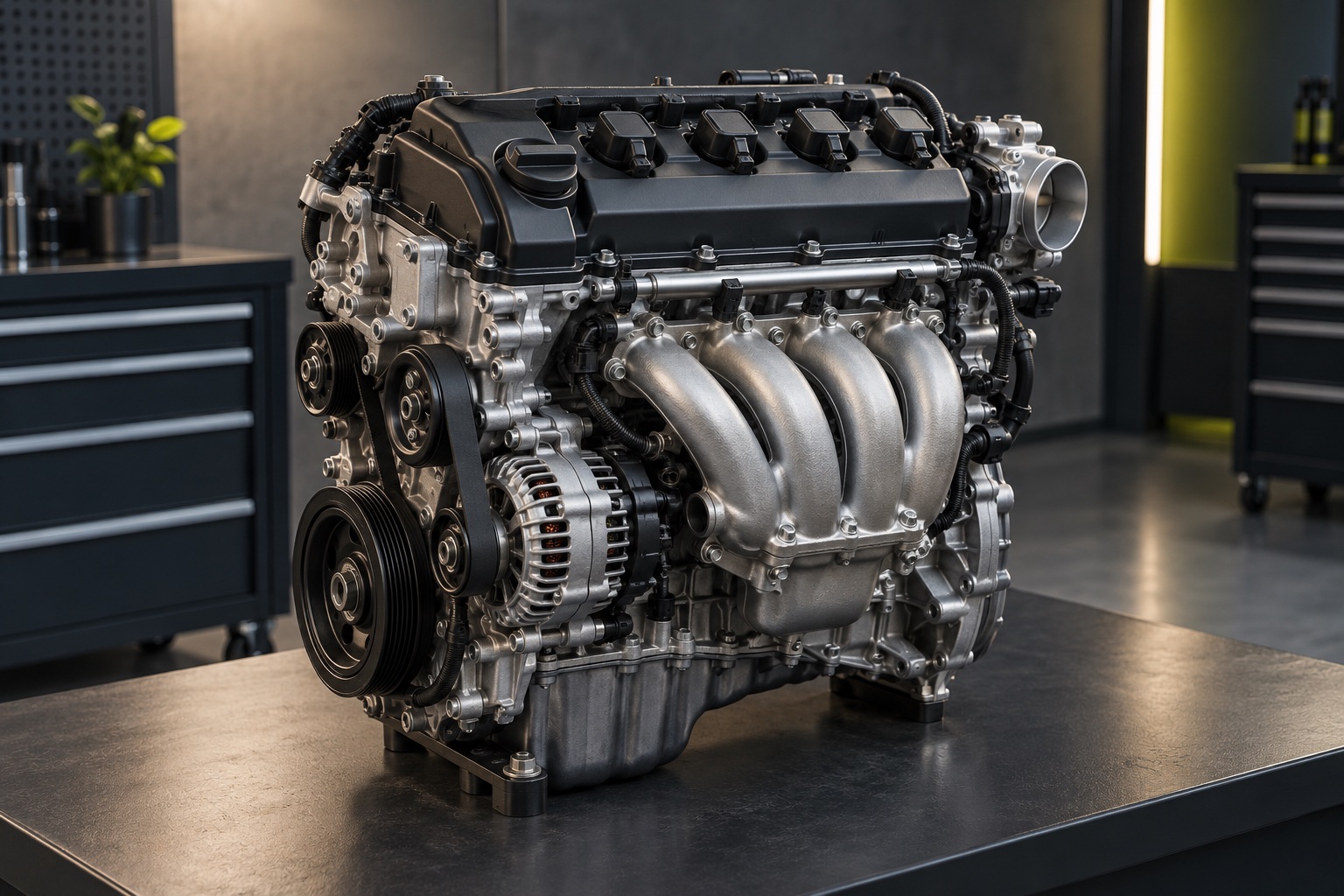
How does a wax thermostat control the cooling circuit?
It changes coolant flow as its temperature-responsive element operates. HELLA's thermostat technical document describes expansion of wax moving a pin and lifting a valve to open the larger cooling circuit. The specified operating temperature belongs to the particular component.
- That is different from a temperature sensor, which supplies information, and from a fan, which changes airflow. A dashboard temperature reading is therefore not a direct measurement of whether the thermostat valve has opened. The technician needs to compare the system's behaviour with the applicable design.
- Some arrangements include an electrical heating element, while others use different integrated housings. The part catalogue should match the actual engine and assembly. A replacement thermostat that fits physically is not automatically the correct operating specification.
Ask the garage to identify the fitted type and the finding that supports replacement. This is especially useful if an estimate includes a whole housing rather than only an insert. The part description should explain the work, rather than hide several different arrangements behind the word “thermostat.”
Why does the complete thermostat assembly affect repair scope?
HELLA distinguishes inserts from integral or housing thermostats in its technical documentation. An integral arrangement combines components such as the insert, cover and seal. That can make the parts and access requirements different from a simple removable insert in another engine.
- Ask which assembly the quote includes and whether associated seals or required fluid are part of the work. A price comparison between an insert and a complete housing is not a comparison of equivalent repairs. Labour can also depend on where the fitted assembly is located.
- If the type uses electrical connections, ask whether the relevant circuit was checked where the complaint requires it. A mechanically operating element and its electrical control are distinct parts of the explanation. The technician should follow the applicable procedure rather than infer a failed assembly from a dashboard message alone.
Avoid choosing a universal opening temperature or removing the thermostat as a routine workaround. The cooling system was designed around a particular control arrangement. A change that conceals one symptom may leave the intended warm-up and circulation behaviour unresolved.
What should the post-repair cooling check confirm?
It should confirm the repaired area and the original operating complaint under appropriate conditions. Ask whether leakage, coolant handling and the relevant temperature behaviour were checked after the work. A new part in the housing is evidence of replacement, not a complete description of the result.
If the original symptom was a rising temperature only at a stop, the workshop should explain which stationary operating conditions it verified. If it was slow warm-up, ask how that condition was assessed. A check unrelated to the original complaint provides a narrower conclusion.
Follow the garage's vehicle-specific instructions for any subsequent level check, and do not remove a hot pressurized cap. Report a returning warning or confirmed level loss rather than repeatedly adding fluid and assuming the new thermostat rules out a problem. Keep the parts description, coolant specification and findings with the invoice. They make a later visit easier to interpret if a cooling symptom returns. The useful conclusion is a working cooling system supported by inspection and verification, not a universal symptom checklist that treats every temperature change as proof of thermostat failure.
How can a map-controlled thermostat differ from a purely mechanical one?
HELLA’s thermostat product explanation distinguishes designs that combine a wax thermostat with an electric heating element. The fitted arrangement determines which mechanical and electrical checks are relevant. The presence of a connector does not mean every cooling complaint is an electrical failure.
The repair proposal should identify the exact thermostat or housing application. If the system has an electronically influenced thermostat, its supply, control information and mechanical behaviour may need separate evaluation under the appropriate procedure. An open circuit and a valve stuck mechanically are different findings.
Do not apply another engine’s opening temperature, wiring values or adaptation requirement. Ask which service information the technician used and how the result supports replacement. A catalogue description helps identify the part; it is not a substitute for testing the actual cooling system.
Keep the broader cooling condition in view. Replacing the control component without addressing a confirmed leak, circulation issue or fan problem can leave the original symptom unresolved. The estimate should identify additional findings rather than imply that a complete housing automatically overhauls the entire system.
Why does restoring the coolant level not complete thermostat verification?
The fluid level is one condition, while circulation and temperature control are operating functions. HELLA cooling-system checks includes different checks for thermostat behaviour, radiator performance and fan operation. A filled reservoir alone cannot show whether the thermostat now responds correctly under the relevant conditions.
The technician needs the specified refill or bleeding procedure and a verification plan appropriate to the vehicle. Those procedures are not interchangeable across engines. The driver should not loosen a hot cap, handle moving components or improvise a bleeding sequence from a generic symptom article.
At collection, ask what was replaced, which coolant specification was used and which original symptom was checked. Slow warm-up, a warning at a standstill and a leak after shutdown are different observations. The repair record should state any limitation if the original condition could not be reproduced.
Follow only the vehicle-specific instructions for any later level check. If a warning, repeated loss or unsafe operating change returns, arrange assessment. A new thermostat is relevant repair history, but it is not evidence that every other cooling component remains serviceable.
What are the signs of a thermostat stuck open or stuck closed?
A thermostat that remains open and one that does not open create different cooling-circuit questions. HELLA cooling-system diagnostics separates slow warm-up from overheating and includes checks of thermostat operation. These are diagnostic patterns, not proof that the thermostat caused every temperature change.
Slow warm-up can lead to checking whether the circuit is remaining open when it should regulate differently. Overheating can lead to checking whether the required circulation path opens. Temperature indication, fan behaviour and other circulation problems still need consideration.
Describe the actual pattern: the temperature gauge rises unusually slowly, cabin heat remains weak, or a high-temperature warning appears under a particular condition. Do not try to find the failure point by leaving the engine running until it overheats.
How can a coolant temperature sensor differ from a bad thermostat?
The thermostat affects the cooling circuit. The coolant temperature sensor provides temperature information to the control system. HELLA temperature-sensor guidance explains why signal and wiring checks can be relevant to temperature-related complaints.
An implausible displayed reading and a genuine overheating condition require different evidence. A technician can compare temperature information, physical system behaviour and application-specific reference values. Replacing a thermostat does not correct a broken sensor circuit.
The water pump and radiator fan also have different roles in circulation and airflow. A cooling-system diagnosis should identify which function fails under the reported condition. A list of possible parts is not an instruction to replace all of them.
If work is needed, identify the thermostat assembly, associated sealing or housing work and correct coolant requirements. The final assessment should cover the original warm-up, leak or overheating concern instead of relying only on a reservoir now filled to its mark.
Thermostat symptoms and other cooling faults
| Pattern | Question to investigate | Avoid assuming |
|---|---|---|
| Slow warm-up | Is temperature regulation correct? | Every thermostat is stuck open |
| Overheating | Is circulation and heat rejection adequate? | Thermostat is the sole cause |
| Changing gauge reading | Does the signal match actual temperature? | The gauge identifies the failed part |
| After cooling-system work | Was the specified procedure completed? | Another part must immediately be replaced |
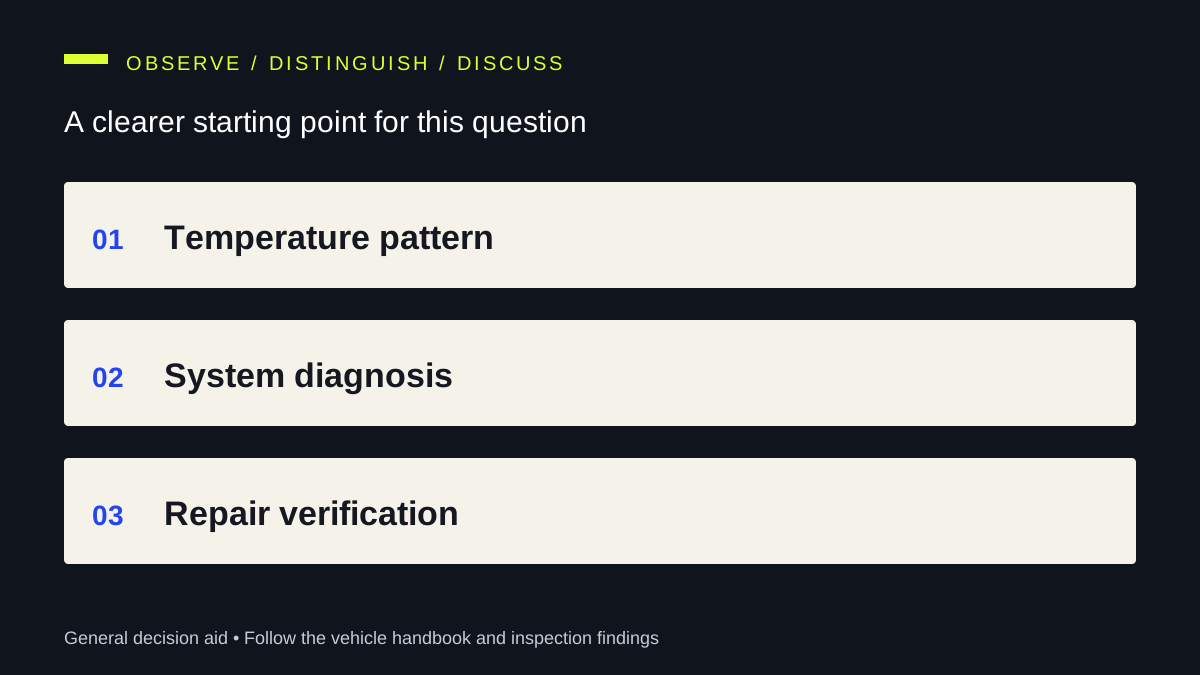
Editorial decision aid. This diagram does not diagnose a vehicle.
Can a coolant leak or thermostat housing fault resemble a failing thermostat?
A thermostat housing and its sealing arrangement belong to the fitted cooling assembly. A leak there concerns fluid retention; a thermostat that does not regulate as intended concerns flow and temperature control. Both can require attention, but the repair scope should identify which finding was made.
HELLA’s cooling-system checks considers leakage, circulation, airflow and temperature indication. Erratic temperature therefore calls for a broader assessment than simply naming a faulty thermostat. Do not touch hot radiator hoses or open the system to test a guess. Report the observed warning and arrange the relevant professional checks.
Which cooling-system observations should you report?
- Record the temperature pattern and warning messages.
- Stop safely if overheating occurs.
- Provide cooling-system repair history.
- Ask which findings confirm the repair and how it was verified.
Discuss your vehicle in Sharjah
For a temperature complaint, bring the coolant and repair history so thermostat work can be considered alongside the rest of the cooling system.
Useful next steps: radiator repair service; contact AS Auto Repair Garage Sharjah; Car Blows White Smoke? Here’s What Your Exhaust Smoke Might Mean.
Frequently asked questions
Can a thermostat fail open or closed?
Different failures can affect its operation. The actual behaviour must be tested for the vehicle.
Can I remove it permanently?
Do not modify the cooling system as an improvised cure. Use the specified repair.
Does a cold heater prove thermostat failure?
No. Heater behaviour is one observation within a broader cooling-system assessment.
Is topping up coolant enough?
A low level needs an explanation. Topping up does not identify a leak or establish safe operation.
Should I replace the temperature sensor too?
Only when testing or the required procedure supports that work. Ask for the reason.
Is the thermostat the same as the coolant temperature sensor?
No. The thermostat regulates coolant flow under its design, while a temperature sensor supplies a signal. A suspect reading, a physical circulation fault and a fan or control problem need separate checks. Replacing the thermostat from one gauge observation can miss the actual cause.
Can a bad water pump look like a bad thermostat?
Cooling complaints can overlap, so circulation, leakage, airflow, temperature indication and the fitted thermostat design need assessment. An overheated engine does not identify one component. Follow the handbook’s safe-stop instructions and do not open a hot pressurized cooling system.
Final answer
- A thermostat regulates coolant flow as part of the temperature-control system.
- Slow warm-up and overheating point to different checks.
- A gauge reading alone does not locate the fault.