Gas Expenses in the U.S.: How to Estimate Your Budget
Gas expenses in the U.S. depend on how much you drive, the fuel your vehicle uses and the price you actually pay. A national household average is a reference point, not the expected bill for an individual driver.
- BLS reports average 2024 spending of $2,645 on gasoline and other fuels per consumer unit. BLS: Consumer expenditures in 2024.
- The monthly equivalent of BLS annual fuel spending is about $220.42 per consumer unit: editorial calculation $2,645 ÷ 12. BLS: Consumer expenditures in 2024.
- The BLS figure includes gasoline and other fuels per consumer unit; it is historical 2024 spending, not a current pump price or a per-driver average. BLS: Consumer expenditures in 2024.
- Estimate your own bill from distance, fuel economy and the price you actually pay. Example inputs in this guide are illustrative, not measured customer spending.
How much do Americans spend on gas, and which year does the average cover?
BLS reports a 1.8% decrease in that category from 2023 to 2024. BLS: Consumer expenditures in 2024
Total transportation expenditure averaged $13,318 in 2024, a broader category. BLS: Consumer expenditures in 2024
BLS records average 2024 spending of $2,645 on gasoline and other fuels per consumer unit. Dividing that annual amount by 12 gives an editorial monthly equivalent of about $220.42. The BLS 2024 report covers the US and a survey spending unit, not an individual driver or today’s fuel price.
Does this U.S. figure apply to Sharjah?
No. It describes a US expenditure survey with US-dollar amounts and its own population definition. A Sharjah fuel budget needs local prices and the vehicle’s actual use. Currency conversion alone does not make a US household average representative of a UAE driver.
Is the BLS figure per driver, per person or per household?
It is an average per consumer unit, so it should not be labelled the spending of an individual driver. In the BLS Consumer Expenditures report for 2024, the unit of analysis is the consumer unit used by the survey. It can include people sharing expenses, rather than representing a single vehicle or a single commuter.
That distinction changes the interpretation. A unit with several drivers and vehicles can spend more than a unit that rarely drives. The published national mean also incorporates variation between locations, incomes and travel needs. It does not tell you what a typical owner of your specific vehicle spends.
Use the category name exactly. “Gasoline and other fuels” is broader than gasoline alone, and neither category is the same as the total cost of owning a car. Financing, insurance, maintenance and parking are separate costs. A headline that turns a broader fuel category into “gas per American” creates an accuracy problem even if its arithmetic is correct.
For your own budget, specify whether you are measuring one car, all household vehicles or only a commute. Keep that scope beside the result. It lets you compare like with like and makes the calculation useful when your travel arrangements change.
How can you calculate monthly fuel costs from your own records?
Use distance, measured fuel economy and the price actually paid. The relationship is straightforward: fuel volume equals distance divided by fuel economy, and fuel cost equals volume multiplied by price. The Fueleconomy.gov cost tools use fuel price and vehicle efficiency to compare spending; personal records make those inputs specific to you.
- Consider an explicitly hypothetical example: 900 miles in a month, 30 miles per US gallon and $3.50 per US gallon. The editorial calculation is 900 divided by 30, giving 30 gallons; multiplying by $3.50 gives $105. These are chosen example inputs, not a current US fuel price or a measured national average. Changing any input changes the answer.
- Check units before multiplying. Miles per US gallon and litres per 100 kilometres are different formats. A fuel receipt in gallons cannot be combined directly with a distance record in kilometres and an efficiency number in litres per 100 kilometres. Choose one consistent system for the calculation.
For records taken between fill-ups, include the odometer difference and fuel quantity. Short or inconsistent partial fill-ups can make a single interval misleading. Keep several records with comparable filling habits rather than treating one unusually expensive receipt as a new permanent monthly cost.
Why can a receipt increase even when you drove the same distance?
The amount paid depends on both the fuel quantity and its unit price. A larger bill can reflect a higher price, more fuel purchased, a different fuel grade or a combination. Separate those variables before concluding that the engine has started consuming more fuel.
Your comparison also needs consistent distance and conditions. A month with more stationary waits, stop-and-go travel or accessory use can differ from a month dominated by steady journeys. Fueleconomy.gov's driving guidance describes unnecessary idling, speed and driving habits as factors in fuel consumption. It does not promise the same saving for every driver.
Record the pump grade and quantity, not just the card transaction total. A purchase that includes other items is not a fuel-only record. If you use more than one vehicle, keep separate logs before calculating a household total. Otherwise, changes in which vehicle made the journeys can look like a deterioration in one car. If consumption rises persistently under comparable conditions, review maintenance and symptoms separately from the arithmetic. A budget calculation can identify a pattern worth investigating. It cannot identify an injector, sensor or tyre fault from spending alone.
What does a consumption change justify checking before buying a repair?
A change needs context before it is called a vehicle fault. US DOE/EPA driving guidance identifies driving conditions and unnecessary idling as factors in fuel use. A delivery route with long stationary waits is not directly comparable with steady highway travel, even if both months show the same odometer distance.
First identify what changed in the records. Was the increase in litres, the amount paid, the price per litre or the distance? Note a warning, rough running, a leak concern or a clear operating change separately. Those observations can justify a relevant mechanical inspection, but a larger receipt by itself does not prove that fuel injectors, plugs or a sensor have failed.
Which costs belong in an average American gas-spending comparison?
Use the same spending category on both sides of a comparison. Gasoline spending, all motor-fuel spending and total transportation spending are different measures. Insurance, vehicle payments, repairs and parking can increase a transportation budget without increasing the fuel purchased.
The national figure quoted earlier is a historical survey reference for its stated year and category. Your current monthly fuel budget needs current receipts or current price inputs. A survey average cannot be converted into a current pump price by dividing it by an assumed tank size.
Separate a household-level question from a vehicle-level one. A household using several cars and a household using public transport contribute different patterns to an average. Neither tells you what a particular commuter will spend on a particular route.
For a useful comparison, write down the category, period, location, unit of spending and whether the figure describes an average or a worked example. If any of those differ, explain the difference before drawing a conclusion about whether your own spending is high.
How can you compare two months without confusing gas prices with fuel economy?
Compare fuel quantity and travel distance before comparing the final bill. More litres or gallons for a similar distance suggests a different consumption pattern. The same quantity at a higher unit price explains a bigger bill without a change in vehicle efficiency.
US DOE/EPA fuel-economy guidance identifies driving behaviour and unnecessary idling as influences on fuel use. A month with more queueing, short trips or different routes can change the consumption comparison. Keep that usage context with the receipts.
A practical log has separate columns for the vehicle, distance, fuel volume, unit price and total paid. Mark a partial fill so it is not mistaken for the fuel used over the whole interval. Use consistent filling records when estimating consumption.
Do not count a repair, lubricant or shop purchase as gasoline merely because it appears on the same card statement. The spending comparison becomes useful when the arithmetic describes the fuel actually purchased and the journeys it supported.
Annual figures and a personal fuel budget
| Measure | Suitable use | Limitation |
|---|---|---|
| BLS consumer-unit average | National spending context | Not an individual-driver bill |
| Receipt and mileage log | Your actual operating cost | Needs comparable periods |
| Budget calculation | Planning future trips | Depends on assumed inputs |
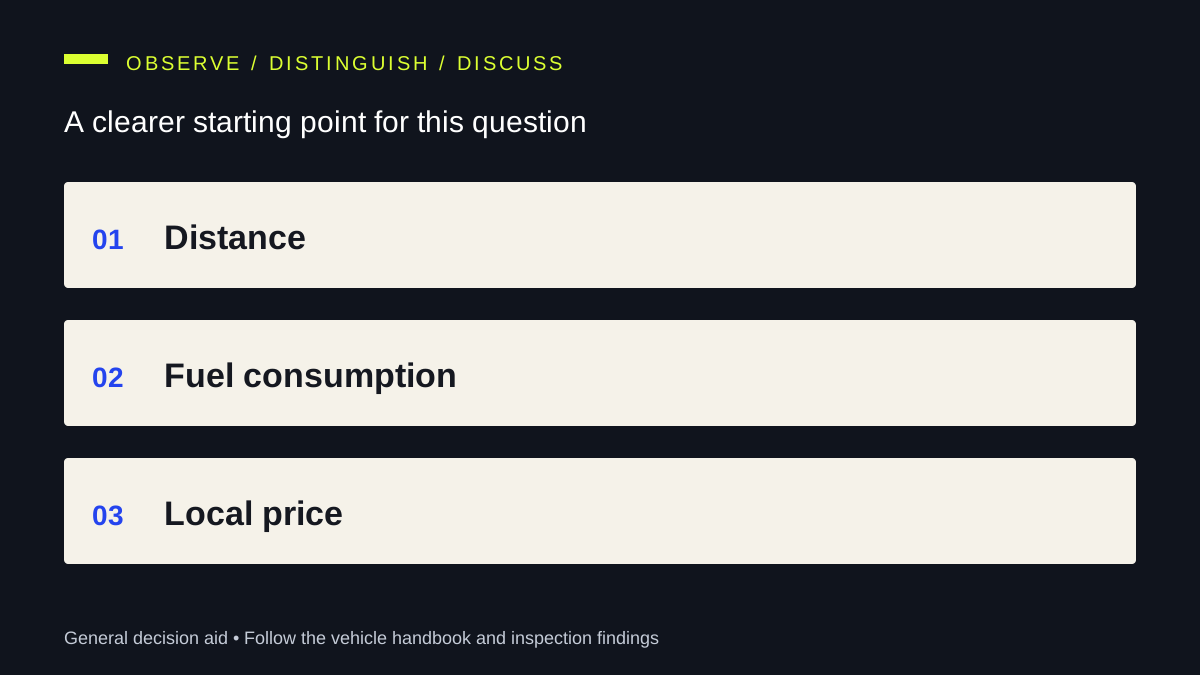
Editorial decision aid. This diagram does not diagnose a vehicle.
Which records make a fuel-budget calculation useful?
- Choose a month or consistent accounting period.
- Record distance and fuel bought using consistent units.
- Calculate measured consumption over multiple refills.
- Apply the pump price you expect to pay.
- Keep parking, insurance and repairs outside the gasoline subtotal.
Related question: Driving on Empty: How Far Can You Really Go?
Frequently asked questions
Is the average per car?
No. The quoted BLS figure is per consumer unit, which may have different numbers of people and vehicles.
Can I use the monthly division as a forecast?
Only as a rough comparison. It is an annual average divided mathematically, not a forecast of your next bill.
Does the figure include insurance?
The fuel category is separate from other transportation expenses. Do not treat it as the total cost of car ownership.
Should I use advertised mpg?
Measured fuel economy is more useful for a personal budget because it reflects your own trips and conditions.
Do premium fuels always reduce cost per mile?
Do not assume that. Follow the fuel specification for your vehicle and compare actual consumption and price.
How much should I budget for gas in 2026?
Use current local fuel prices, your planned travel distance and measured fuel economy. The historical BLS average quoted in this guide remains labelled by its survey year and spending category. It is not a live 2026 pump-price quote or a forecast for a particular household.
Can a higher gas bill mean the car needs repair?
Possibly, but separate the unit price, travel distance and fuel quantity first. A more expensive fill at the same quantity may reflect price alone. A repeatable increase in fuel used for comparable driving gives a more useful reason to investigate vehicle condition.
Final answer
- A consumer unit is not the same as one driver.
- Separate gasoline spending from the broader gasoline-and-other-fuels category.
- Build your budget from distance, measured fuel economy and local pump price.