Driving Without a Catalytic Converter: What to Know
Driving without a catalytic converter is not simply a question of whether the engine will run. A missing or damaged converter can leave an exhaust-system problem, an emissions fault and a compliance issue. Have the vehicle assessed rather than treating extra noise as the only consequence.
- A car running without a catalytic converter is not evidence that its exhaust is safe or compliant.
- US EPA identifies converter removal without an approved replacement as prohibited US federal tampering. US EPA: vehicle emissions questions.
- An exhaust leak can allow carbon monoxide into the cabin. CDC: carbon monoxide poisoning.
- Confirm whether the converter is missing, an exhaust leak exists or another engine fault damaged the converter; the repair scope differs.
Why does a missing converter need an exhaust inspection?
The converter is part of the exhaust and emissions-control system. If it has been cut out or damaged, the surrounding pipework, sensors and supports may also need assessment. Ask the workshop to document the complete affected area, not just quote the visible missing part.
Record when the noise appeared, any warning messages and whether the incident followed an impact or suspected theft. Photographs can help an insurer or repairer, but do not crawl underneath an unsupported vehicle to obtain them.
Is it safe if there is no smell?
No smell does not establish safety. CDC: carbon monoxide poisoning explains that carbon monoxide cannot be detected by smell and that vehicle exhaust leaks can be hazardous. Do not idle in an enclosed area or continue driving with suspected exhaust entering the cabin.
Arrange recovery if the exhaust is damaged, hanging down or the vehicle cannot be used safely. The decision should follow the actual condition, not a generic distance that someone else drove after a theft.
Does an engine continuing to run mean the exhaust is acceptable?
No. The ability to start and move is different from the exhaust system being complete, safe and compliant. A missing converter can leave a different physical condition from a converter replaced by another part, so ask what is actually missing or damaged.
The CDC's vehicle-exhaust guidance explains that an exhaust leak can allow carbon monoxide to build up inside a car. That is a reason to consider leakage and exposure before driving. It is not a statement that every missing converter causes the same cabin exposure, because the location and remaining exhaust condition differ.
Describe sudden changes in sound, visible damage and any warning that appeared. Do not crawl under an unsupported vehicle or inspect hot exhaust components. If theft is suspected, record the visible evidence from a safe position and arrange a professional assessment or recovery.
A running engine should not be used as a clearance test. Ask the garage whether the vehicle can be used in its current condition and what inspection supports that answer. If the exhaust is open or fumes are entering the cabin, the immediate response belongs to the safety problem, not to finding a longer allowable driving distance.
What does US EPA guidance say, and where does that answer apply?
The US EPA emissions FAQ states that removing a catalytic converter without an approved replacement is prohibited tampering under US federal law. The jurisdiction belongs in that sentence. It does not establish the text of UAE rules or the outcome of a Sharjah inspection.
If your vehicle is registered or used in the UAE, confirm the applicable repair and inspection requirements with the relevant authority or test provider. Avoid importing an American penalty or exemption from an online article into a different legal system. Check the applicable requirements with the local vehicle authority before altering emissions equipment.
A theft-related repair and an intentional emissions modification also present different circumstances. The garage can document the mechanical condition and proposed replacement, while an insurer or authority may require its own records. Ask what documentation is needed before agreeing a repair if a claim is involved. Keep the replacement specification visible in the estimate. “Fit an exhaust part” is less informative than naming the appropriate converter and associated work. Legal compliance and mechanical fit are both reasons not to choose a component solely because it is cheap or appears to eliminate the warning.
Why should a converter replacement include investigation of the underlying engine complaint?
A converter complaint can be associated with another unresolved engine-running problem. A vehicle that was shaking or misfiring before the exhaust warning needs that history considered. Installing a new converter without understanding the original complaint can leave a separate fault unaddressed.
The DENSO ignition troubleshooting guide distinguishes misfire symptoms from a confirmed coil failure and calls for inspection of the ignition system. It provides a relevant diagnostic route when combustion symptoms are part of the history, rather than a reason to replace coils automatically.
Ask what the technician found: missing hardware, damaged material, leakage, sensor faults or an engine condition requiring additional work. The scope should follow those findings. A converter removed by theft does not establish that the engine previously damaged it, while an engine-running fault is not resolved by repairing a cut exhaust pipe alone.
Request the reason for any associated parts and testing in the quote. Sensor replacement, wiring repair and engine diagnosis should each have a stated purpose. This keeps a necessary exhaust repair from becoming an unexplained package of components.
What should be checked before the car returns to normal use?
Ask for the exhaust's physical condition, the relevant monitoring result and any remaining engine-running concerns to be reviewed. The garage should explain what was verified after repair and what remains outside the work agreed.
- If the original event involved theft, keep the repair record, photographs and part description for any appropriate follow-up. If the complaint involved a warning before the converter issue, preserve the diagnostic findings as well. These records answer different questions and help avoid repeating an unsupported diagnosis at a later visit.
- Confirm the applicable inspection requirements before assuming that a quiet exhaust is sufficient. A reduced noise level is one observation; it does not prove correct emissions-control operation or compliance with the relevant registration process.
Why should the repaired exhaust be checked as a complete assembly?
Joint integrity and routing matter after replacement. CDC carbon-monoxide guidance warns that an exhaust leak can allow carbon monoxide to build up inside a vehicle. The inspection therefore needs to address the repaired exhaust path, not just the appearance of a new metal casing beneath the car.
Do not use the absence of a smell, a warning temporarily turning off or the engine continuing to run as proof that the whole issue is resolved. The documented component fit, exhaust condition, relevant diagnosis and applicable compliance requirements answer different parts of the decision.
What do the catalytic converter and oxygen sensors do differently?
The catalytic converter and oxygen sensors are related parts of the exhaust and engine-management arrangement, but they are not interchangeable. HELLA lambda-sensor guidance describes sensing positions and the checks needed to interpret their signals.
A sensor measures a condition used by the control system. A converter is the exhaust-treatment component being evaluated in that arrangement. Replacing a sensor is therefore not a generic substitute for installing missing converter hardware, and replacing a converter is not a diagnosis of a damaged sensor connection.
After suspected theft, the inspection should identify the absent component, cut sections, mounting damage and any affected wiring. After an efficiency warning with the converter still present, the diagnostic question is different: the technician needs to evaluate the relevant system behaviour and surrounding conditions.
Can an exhaust leak make driving without a catalytic converter unsafe?
An exhaust leak can expose occupants to harmful exhaust gases. CDC carbon-monoxide guidance explains the carbon-monoxide risk from vehicle exhaust. A cut or altered exhaust needs assessment of the whole affected path, not just a decision about whether the engine will start.
Noise is one observable symptom. It does not measure the gas entering a cabin, the condition of sensor wiring or compliance with vehicle requirements. Do not use quieter running after a temporary patch as proof that all of those concerns have been resolved.
For a replacement proposal, identify the correct application and the associated joints, mounts and sensor work. A part advertised for a different vehicle cannot be assumed suitable merely because the pipe appears to fit.
The legal answer must also match the jurisdiction. This guide’s cited US EPA rule concerns US law. Obtain the applicable local requirements from the responsible authority for your registered vehicle rather than using a foreign penalty or exemption as a Sharjah answer.
Catalyst symptoms and replacement questions
| Finding | What needs checking | Insufficient reassurance |
|---|---|---|
| Missing converter | Correct replacement and related damage | The engine starts |
| Open or leaking exhaust | Exhaust integrity and cabin exposure | There is no smell |
| Warning lamp | Codes and repair verification | The lamp was erased |
| Proposed bypass | Compliance and proper repair | Other drivers do it |
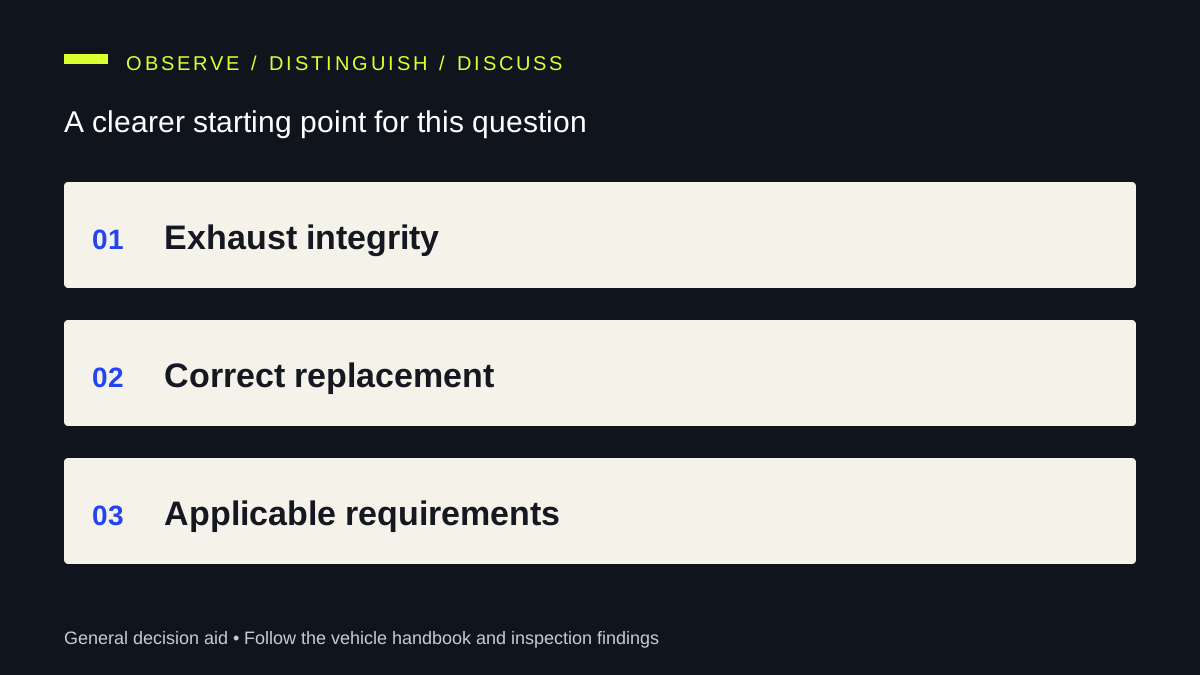
Editorial decision aid. This diagram does not diagnose a vehicle.
What should you do after suspected catalytic converter theft?
Arrange assessment of the exhaust and surrounding installation before returning to normal use. A suspected stolen catalytic converter can leave damage beyond the missing hardware. Describe any new noise, warning or visible damage without entering an unsafe roadside position or crawling under an unsupported vehicle.
Catalytic converters, oxygen sensors and a muffler have different functions in an exhaust installation. A sensor warning does not restore the emission-control hardware, and a quieter exhaust does not establish that the required converter is present. Confirm the repair and the local inspection requirements; this guide does not quote a universal UAE fine or promise an emissions-test result.
Which exhaust findings should you report before repair?
- Park safely and document visible damage.
- Avoid enclosed-space operation.
- Contact the insurer or relevant authority if theft is suspected.
- Obtain an inspection-based repair scope.
Discuss your vehicle in Sharjah
A missing or damaged converter needs an exhaust assessment that addresses leaks, emissions equipment and any underlying running fault.
Useful next steps: car diagnostic service; contact AS Auto Repair Garage Sharjah; Car Shuts Off While Driving? Here’s How to Troubleshoot It.
Frequently asked questions
Will the engine always stop without it?
No. Engine operation and safe, compliant vehicle use are separate questions.
Can I drive a fixed distance to the garage?
There is no universal safe distance for unknown exhaust damage. Arrange advice or recovery based on the condition.
Will removing the warning light fix it?
No. Suppressing a warning does not restore missing hardware or repair an exhaust leak.
Do US rules apply in Sharjah?
Do not assume so. Check the rules for the vehicle’s registration jurisdiction.
What should the quote include?
The correct converter, associated pipework or sensor damage, fitting and the checks needed to verify the repair.
Can I keep driving if the catalytic converter is missing?
Do not treat the engine continuing to run as proof that the exhaust is suitable or the vehicle meets applicable requirements. A damaged or incomplete exhaust needs assessment, including leakage and the fitted sensor arrangement. Confirm the relevant local requirements with the responsible authority.
Will an oxygen sensor repair replace the catalytic converter?
No. A sensor measures conditions at its installation point; the converter is exhaust-treatment hardware. A sensor or wiring fault and a missing converter require different findings and work. Deleting a warning or replacing a sensor does not restore physically absent hardware.
Final answer
- An engine starting does not establish that the exhaust is safe.
- A missing converter and an exhaust leak are related but different findings.
- Emission-control rules depend on jurisdiction.