Sugar in a Gas Tank: What to Do About Contamination
What happens if you put sugar in a gas tank? Treat suspected contamination as a fuel-system inspection problem. Do not rely on dramatic claims that the engine must be ruined, or reassuring claims that nothing can happen. The material, vehicle and extent of circulation need to be established.
- Suspected sugar in the fuel tank should be handled as contamination; avoid further start attempts while the fuel path is assessed.
- Delphi’s fuel-pump example documents debris from a tank and charcoal canister, not a measured sugar-damage threshold. Delphi pump example.
- A new fuel pump does not remove debris remaining in the tank. Tank cleaning and component replacement are separate tasks.
- Preserve evidence and use a professional contamination assessment; do not add a second substance to dissolve or neutralize the material.
Does contamination automatically destroy the engine?
No diagnosis can be made from the suspected substance alone. Delphi: contaminated fuel pump shows why contamination in a fuel system must be addressed, including the tank, rather than simply installing another pump. That guidance does not prove a particular outcome for sugar in every vehicle.
Distinguish a suspicion from a confirmed finding. A damaged filler cap, visible residue or a sudden running problem is useful evidence, but none identifies the material inside the tank with certainty.
What should you do before the vehicle is inspected?
Avoid further operation and explain the concern to the recovery provider or workshop. Keep any photographs of the filler area and note whether the engine ran after the suspected event. Do not remove or handle fuel beside traffic.
If deliberate damage is suspected, preserve the evidence and ask the relevant authority or insurer what documentation is needed. Do not clean away the evidence first or publish an accusation based only on a running fault.
Why might tank cleaning be part of a fuel-pump repair?
Replacing a failed pump does not automatically remove contamination elsewhere in the fuel supply. Delphi's tank-cleaning guidance specifically connects tank condition with a sound pump replacement. The principle is to address the contamination source rather than introduce a new part into an unresolved environment.
- For your estimate, ask whether inspection found contamination and what cleaning or removal work is proposed. A pump-only quotation and a quotation that includes tank work cover different tasks. The garage should explain why the latter is needed rather than presenting cleaning as a universal extra for every starting complaint.
- Fuel handling is professional work. Do not open the tank, drain petrol into improvised containers or test a suspected substance at home. Flammable vapour, electrical components and disposal requirements make this different from checking an ordinary service record.
If the shop recommends further fuel-path work, ask which findings justify each stage. Cleaning the tank, replacing a pump and investigating injector operation should be connected to evidence. The mere possibility that contamination could travel does not establish that every downstream part must be replaced.
What if the car already ran after you discovered the concern?
Tell the technician exactly what happened, including whether it started normally, hesitated, stopped or failed to restart. Do not run it again simply to see whether it improves. The event history helps define the inspection, but it cannot quantify damage without checks.
Separate “cranks but will not start” from “does not crank.” A no-crank complaint belongs to the starting system as well as the overall event history. It should not automatically be attributed to tank contamination. If the engine turns but does not start, the technician still needs to distinguish fuel supply from other causes of poor combustion.
Also preserve the relationship to refuelling. A fault that began after a purchase of fuel is a timing observation. It is not proof that the retailer supplied contaminated fuel or that another person tampered with the vehicle. Keep the receipt and describe the sequence so it can be investigated properly. Do not add a fuel-system cleaner or another substance as a general antidote. The appropriate response depends on what is actually present and the condition found. An additive recommendation without identifying the problem can complicate assessment and is not a substitute for inspecting the tank and supply path.
What should a repair report and follow-up check contain?
An estimate can be staged: inspection first, then authorized cleaning or component work based on the results. Agree how the shop will seek approval if the scope changes. “Possible contamination” should not become a blanket authorization for an engine replacement without supporting evidence.
If suspected deliberate damage also requires a report to an insurer or relevant authority, keep factual observations and invoices. A workshop's mechanical diagnosis cannot automatically establish intent or responsibility. The immediate aim is a safe assessment of the vehicle, without extending a myth into an unsupported accusation or an unnecessary repair.
Can a starting symptom identify the material in the tank?
A no-start, stall or rough idle cannot identify sugar or another contaminant on its own. Those symptoms can arise from unrelated supply, ignition or mechanical problems. The repair proposal needs inspection evidence about the fuel system, especially when the concern began with suspected deliberate contamination rather than a confirmed finding.
Delphi’s contaminated-pump example shows contamination in removed parts and discusses material entering from the tank. It is an example of observed contamination, not a chemical test that proves any material found in your car is sugar.
Tell the garage how the concern was discovered: a witnessed event, visible material near the filler or only an unexplained running problem. Keep those categories separate. A person’s suspicion can justify investigation without becoming the published or invoiced diagnosis.
If evidence is required for an insurer or police report, ask the relevant organisation about its documentation process before anything is discarded. Do not taste, burn or otherwise improvise a test of an unknown fuel sample. Handling and identifying contaminated fuel belong with an appropriately equipped professional and the procedure applicable to the case.
Why are the fuel tank, pump inlet and injectors inspected separately?
Contamination begins as a finding in a particular location. Material in the fuel tank, material at the pump inlet and a failed injector test are separate observations. Delphi’s contaminated fuel-pump example shows why the removed assembly and tank condition can matter to the investigation.
Start with what was actually found. A visible deposit at the bottom of the tank does not describe every component downstream. Conversely, a running complaint after suspected contamination cannot establish what the material is or where it travelled.
The inspection can then follow the fitted fuel path. The pump arrangement, filter location and access requirements vary by vehicle. A universal claim that every contaminated car needs all injectors replaced ignores those differences and skips the tests that would support replacement.
Does cleaning a sugar-contaminated gas tank mean the fuel pump also needs replacement?
Not automatically. Removing suspected contamination addresses the source material. Replacing a fuel pump addresses a component that has failed the applicable inspection or test. The technician should establish which operations are needed rather than treating them as a fixed package for every allegation.
Delphi tank-cleaning guidance connects tank cleanliness with pump service. Installing a new pump into an unresolved contamination problem can leave the original concern in place.
A useful sequence is inspection of the fuel and tank, identification of affected areas, assessment of relevant components, and a repair plan based on those findings. Unknown material needs appropriate handling; do not attempt a home solvent experiment or burn a sample.
If the car has not been started since suspected tampering was discovered, tell the repairer before anyone operates it. If it already ran, describe how long it operated and the symptoms you noticed, without guessing a guaranteed damage timetable.
Fuel contamination findings and repair scope
| Situation | Useful action | Avoid |
|---|---|---|
| Contamination suspected before starting | Arrange inspection without running | A test drive |
| Vehicle already ran | Report duration and symptoms | Repeated restart attempts |
| Material not identified | Preserve evidence for assessment | Declaring the engine destroyed |
| Pump replacement proposed | Ask about tank and fuel-path cleaning | Replacing parts without addressing residue |
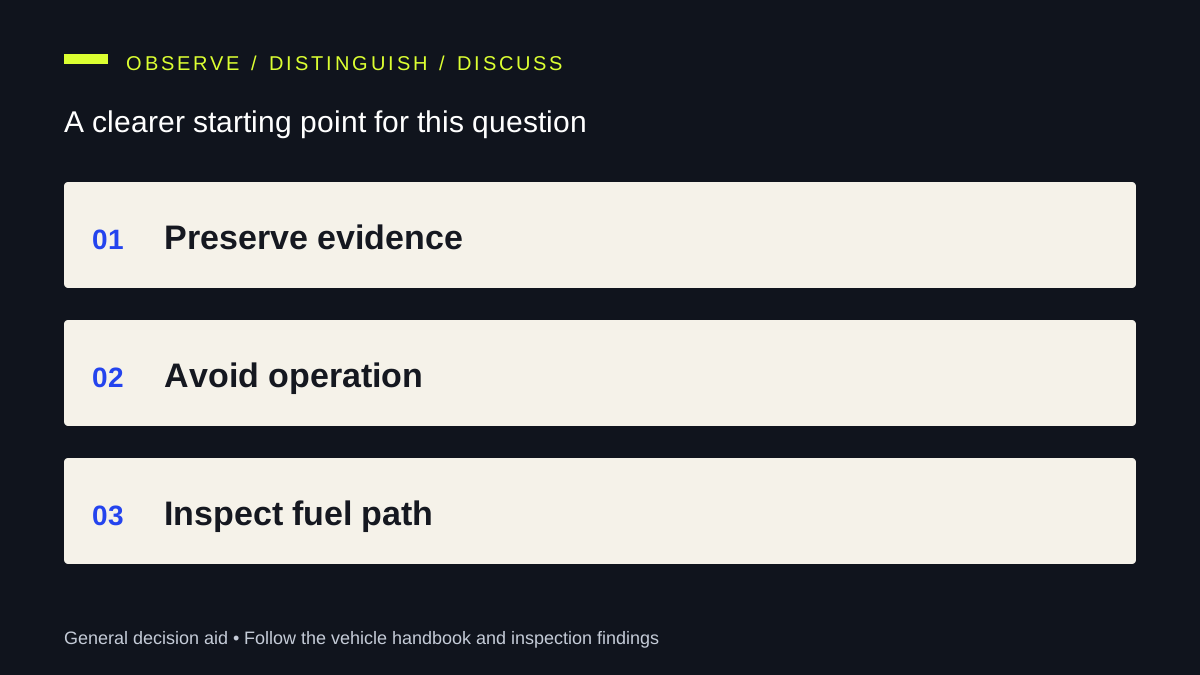
Editorial decision aid. This diagram does not diagnose a vehicle.
What information helps assess suspected fuel contamination?
- Stop further starting attempts.
- Record the visible evidence without handling fuel.
- Arrange recovery and explain the concern.
- Request documented findings and a scoped estimate.
Discuss your vehicle in Sharjah
Tell the workshop about the suspected material and whether the engine ran afterward before arranging inspection or recovery.
Useful next steps: fuel injector cleaning service; contact AS Auto Repair Garage Sharjah; Car Shuts Off While Driving? Here’s How to Troubleshoot It.
Frequently asked questions
Should I dilute it with more fuel?
Do not add fuel or chemicals as an improvised remedy. Let the workshop establish the contamination and cleaning method.
Can a fuel additive fix it?
An additive is not a substitute for identifying and removing foreign material.
Will the filter protect everything?
Do not assume that. The actual fuel-system layout and contamination need assessment.
Does rough running prove sabotage?
No. Many faults cause rough running. Preserve evidence and avoid jumping to conclusions.
Can the vehicle be repaired?
The answer depends on inspection. Neither total engine failure nor a minor cleaning job can be promised in advance.
Will sugar in a gas tank always destroy the engine?
An automatic destruction claim is not supported by the observation alone. Suspected contamination needs safe handling and identification of the actual material and affected parts. Tank contamination, restricted fuel delivery and an established component failure are separate findings that determine the repair scope.
Can fuel-injector cleaning remove contamination from the tank?
Injector service addresses the injector procedure; it is not a substitute for assessing the tank and fuel supply. A repair plan needs to address where contamination remains and whether a pump, filter or injector has a confirmed fault. A generic cleaning package cannot answer those questions in advance.
Final answer
- Avoid starting or restarting a vehicle with suspected fuel contamination.
- Do not add another substance to try to dissolve or neutralize it.
- Preserve photographs and a record of when the problem appeared.